

Third-party litigation funding could add $50 billion in costs to the U.S. insurance industry over the next five years. The carriers that survive that pressure will be the ones that stop treating legal abuse as a claims problem and start treating it as an enterprise risk.
- $50B Projected TPLF cost added to U.S. insurers over 5 years (EY / APCIA, 2024)
- $10M+ Threshold where a single verdict reshapes reserves, pricing, and reinsurance
- Rising Average jury awards are directly tied to litigation funding dynamics
What legal abuse means for your book of business
Legal abuse is not just frivolous lawsuits. It is the systematic use of legal process to exhaust, delay, and extract. Filing motions with no merit, flooding discovery to drive up defense costs, funneling claims through aggressive attorney marketing campaigns, and assigning benefits to third parties who litigate instead of settle. Each tactic alone is manageable. Together, they reshape loss ratios.
The Insurance Information Institute has documented the link between abuse of the legal system, higher claim payouts, and elevated loss adjustment expenses. The pressure shows up in premiums, in reserves, and, eventually, in your rating-agency conversations.
Third-party litigation funding changes the economics of a claim. When an outside investor backs a plaintiff in exchange for a share of the recovery, the plaintiff has less incentive to settle early and more capacity to absorb prolonged litigation. Defense cost escalation follows.
The five patterns driving claim cost inflation
1. Meritless filings used as attrition tools
Repeated motions and lawsuits filed not to win on the merits, but to impose cost and delay. The plaintiff’s goal is financial exhaustion. Defense cost is real regardless of the outcome.
2. Discovery used as a cost weapon
Excessive document demands, non-compliance, and serial extension requests inflate defense spend without advancing any legitimate legal argument. This tactic works because time and cost accrue regardless of the case’s merit.
3. Third-party litigation funding
Outside capital backing plaintiffs lowers the cost constraint on litigation. Funded plaintiffs hold out longer, target higher verdicts, and resist early resolution. TPLF arrangements are often opaque, making exposure difficult to quantify until it is too late to change strategy.
4. Attorney advertising campaigns
Billboard and broadcast campaigns, often funded by the same investors backing litigation, generate high claim volumes in targeted lines. Commercial auto and trucking are frequent targets. Claim frequency and individual claim cost both rise.
5. Assignment of benefits abuse
In homeowners, auto, and property lines, AOB schemes route claims through contractors or legal firms. The assigned claim is then inflated and litigated rather than resolved. Florida and other high-litigation states have documented the cost impact at scale.
This is an underwriting problem, not just a claims problem
Legal abuse affects every function that touches a litigated file. Underwriting models built on prior-period data underestimate current exposure. Reserves set without accounting for TPLF or Nuclear Verdict® risk are structurally inadequate. Defense panels operating without abuse-pattern guidelines miss early signals that change settlement strategy.
The APCIA has backed federal legislation, including the Lawsuit Abuse Reduction Act of 2025 (H.R. 5258, 119th Congress), which targets stricter mandatory sanctions for frivolous lawsuits and greater TPLF transparency. Regulatory pressure is building. Carriers that have not embedded legal abuse risk into their governance frameworks are behind.
Nuclear Verdicts® are the peak outcome of unmanaged legal abuse. When TPLF-backed litigation reaches a jury without early intervention, the result is not just a large verdict. It is a missed reserve, a reinsurance conversation, and a pricing correction across the entire line.
Want to identify claims with Nuclear Verdict® exposure before they reach trial? Request a demo to see how Schaefercity.ai helps carriers move from reactive management to earlier risk detection.
A practical mitigation framework for carriers and counsel
Underwriting and product design
Price legal abuse risk into lines with documented exposure: commercial auto, umbrella, and homeowners in high-litigation jurisdictions. Review policy language for clarity on exclusions and cooperation requirements. Consider higher retentions in segments where attorney advertising activity is concentrated.
Claims triage and analytics
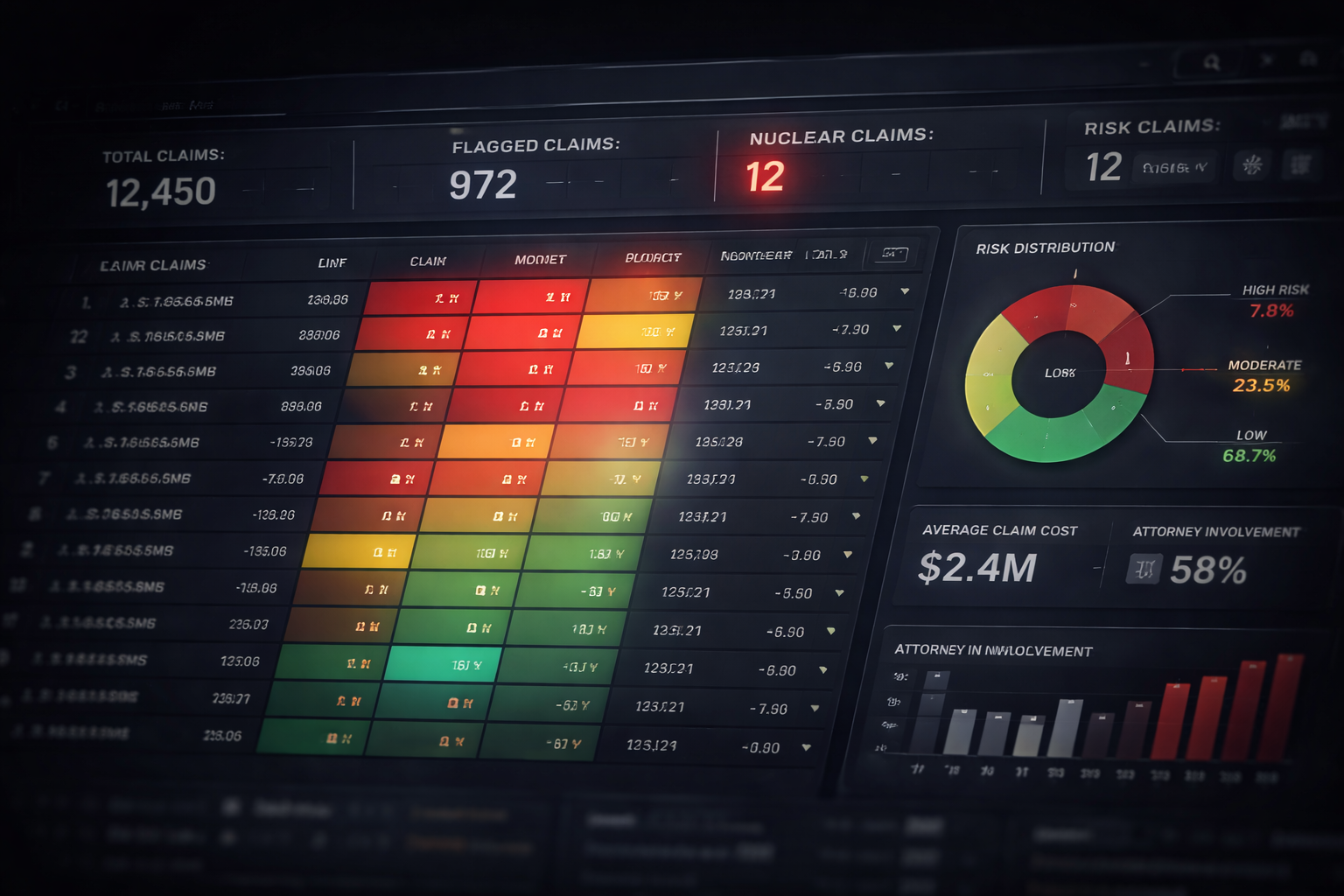
Flag early indicators: repeat plaintiff attorneys, post-assignment filings, unusual discovery volume, and signs of funding involvement. Build or update dashboards tracking claim lifecycle duration, settlement-to-trial ratios, and attorney filing frequency. Early identification changes the economics of the file.
Contract and governance review
Require disclosure of TPLF arrangements where possible. Reinforce cooperation clauses and subrogation rights in policy wordings. Update defense panel guidelines to include abuse-pattern criteria and require early escalation when funding or aggressive tactics are present.
Regulatory and legislative engagement
Monitor TPLF disclosure bills and sanctions legislation by jurisdiction. Engage through trade associations to support reforms that improve underwriting conditions. The regulatory environment is shifting; carriers that track it closely will adapt faster.
Cross-functional training
Legal abuse risk is not visible to any single team. Underwriting, claims, actuarial, and legal each see a piece of it. A shared framework, common indicators, and cross-functional ownership convert siloed awareness into coordinated action.
Prediction beats reaction at every stage of a litigated claim
The carriers that absorbed the worst outcomes of legal abuse share one trait: they identified the risk too late. The file that settled for $8 million at demand and returned a $27.5 million jury award did not become a Nuclear Verdict® at trial. It became one at FNOL when the early indicators were present and undetected.
NaVel® identifies Nuclear Verdict® risk in live claim files from first notice through litigation, updating continuously as the file develops. Early detection gives claims professionals a window to act before an unmanaged pattern of legal abuse reaches a jury.
See how NaVel® flags legal abuse risk before it reaches trial. Run your closed claims for free and benchmark your current exposure. Request a free pilot at schaefercity.ai/request-a-demo
FAQS
What is legal abuse in insurance?
Legal abuse in insurance refers to the systematic misuse of legal processes to exhaust, delay, and extract value. It includes meritless filings, discovery abuse, third-party litigation funding, aggressive attorney advertising, and assignment-of-benefits schemes that inflate claims and avoid resolution.
How does TPLF drive Nuclear Verdicts®?
TPLF provides plaintiffs with outside capital, removing cost constraints on litigation. Funded plaintiffs hold out longer, resist early settlement, and push cases to trial where Nuclear Verdict® risk is highest. EY analysis estimates TPLF could add up to $50 billion in costs to U.S. insurers over the next five years.
What is the Lawsuit Abuse Reduction Act of 2025?
H.R. 5258, introduced in September 2025 by Rep. Mike Collins (GA-10), would restore mandatory sanctions for frivolous federal court filings and eliminate the 21-day safe harbor that currently allows abusive filings to be withdrawn without penalty after harm is done.
How can carriers detect legal abuse risk early?
Early indicators include repeat plaintiff attorneys, post-assignment filings, high discovery volume, and signs of litigation funding. AI tools like NaVel® identify Nuclear Verdict® risk in live claim files from FNOL through litigation, updating the risk score continuously as the file develops.
What lines of business are most exposed to legal abuse?
Commercial auto, umbrella, and homeowners in high-litigation jurisdictions carry the highest exposure. Assignment of benefits abuse is especially concentrated in property and auto lines in states like Florida.
Source
- Ernst & Young (EY) analysis, APCIA Annual Meeting 2024. Reported by Insurance Business America, Oct 8 2025. insurancebusinessmag.com
- Lawsuit Abuse Reduction Act of 2025, H.R. 5258, 119th Congress. Introduced September 2025, Rep. Mike Collins (GA-10). congress.gov/bill/119th-congress/house-bill/5258
- Insurance Information Institute (Triple-I): Legal system abuse and loss ratio impact. iii.org
- American Property Casualty Insurance Association (APCIA): Legal system abuse reform, 2025-2026. apci.org