

For years, medical malpractice risk models depended on historical patterns. Settlement ranges were more stable. Defense teams could make assumptions based on prior outcomes. That environment has changed. Once verdicts cross the $10 million threshold, the impact is no longer limited to one file. It affects reserves, pricing assumptions, reinsurance conversations, defense strategy, and portfolio confidence.
The real issue is not just larger verdicts. It is later detection. Most claims organizations still identify severe medical malpractice exposure too late. By the time a pattern is visible through incident reviews, legal reports, or reserve escalation, the file may already be deep into litigation. The operational blind spot is not a lack of data. It is the inability to connect signals early enough to change the outcome.
What’s actually driving nuclear verdicts®
1. Jury sentiment has changed
Jurors are increasingly less sympathetic to institutions and more willing to assign large awards when harm appears preventable. In medical malpractice, that can turn a documentation failure, communication lapse, or delayed intervention into a story of systemic indifference rather than a single clinical mistake.
2. Plaintiff strategy increasingly focuses on system failure
The argument is often no longer limited to what happened in one encounter. It becomes a claim that the insurer, provider group, hospital, or broader system allowed a repeatable danger to exist. When the defense cannot show early recognition or corrective action, that framing becomes more powerful.
3. Anchoring pushes verdict expectations higher
When plaintiff counsel introduces very large damages numbers early, it changes how juries think about value. Even when the ultimate award comes in below the initial ask, the baseline has already moved.
4. Future care costs keep expanding
Medical inflation and long-term life care projections can materially raise economic damages in a med mal case before noneconomic or punitive factors are even considered. This makes early exposure recognition more important because reserve assumptions built on older loss environments may understate what a current case can become.
5. Large verdicts reset expectations across the market
High-value medical malpractice verdicts do not stay contained. They circulate through legal networks, news coverage, plaintiff marketing, and internal claims discussions. Over time, they influence how attorneys negotiate, how jurors interpret damages, and how organizations think about what is possible.
Where med mal insurers and claims teams are most exposed
The common failure point is fragmented visibility. Medical malpractice exposure is rarely created by one catastrophic data point appearing all at once. It builds through combinations of weak signals: delayed care, poor documentation, unresolved patient complaints, communication breakdowns, weak handoffs, and repeated workflow failures across teams.
For insurers, that creates a practical problem. Clinical facts may sit in one system, claim notes in another, legal assessments somewhere else, and patient experience signals outside both. A plaintiff attorney can stitch those facts into a story of systemic failure. Many carriers still cannot do the same thing early enough on the defense side.
The cost of a nuclear verdict® is bigger than the verdict
A nuclear medical malpractice outcome does not just create one large indemnity event. It can pressure self-insured retentions, push insurance premiums higher, increase defense spend, damage reputation, and make retention harder in already strained operating environments. For insurers and reinsurers, that means the true cost sits at the portfolio level, not just in a single closed file.
Why reactive claims management is no longer defensible
Traditional risk management still tends to rely on incident reports, retrospective reviews, manual audits, and periodic legal updates. That approach is too slow for an environment where plaintiff strategy is sophisticated, valuation anchors are higher, and catastrophic exposure can be developing long before formal litigation signals appear.
For med mal insurers, the practical consequence is clear: by the time a file clearly looks dangerous, the economics of the case may already have changed. Discovery has advanced. Experts are set. Narratives are established. Reserve moves become defensive rather than strategic.
What needs to change in the med mal claims workflow
- Real-time risk detection: Early signals need to be surfaced as they happen, not months later. Complaints, care delays, documentation inconsistencies, and repeat failures across similar files should be treated as exposure indicators, not just operational noise.
- Cross-functional visibility: Clinical, claims, legal, and operational data cannot remain disconnected. Nuclear Verdict® exposure forms across the workflow, so visibility has to work across the workflow too.
- Pattern recognition at scale: Individual events do not always look catastrophic in isolation. Patterns do. The ability to identify recurring failure points across files, departments, counsel, venues, or workflows is where AI becomes strategically useful.
- Earlier intervention: The goal is not better reporting after the fact. It is changing the file trajectory before litigation pressure hardens.
Where Schaefercity.ai fits
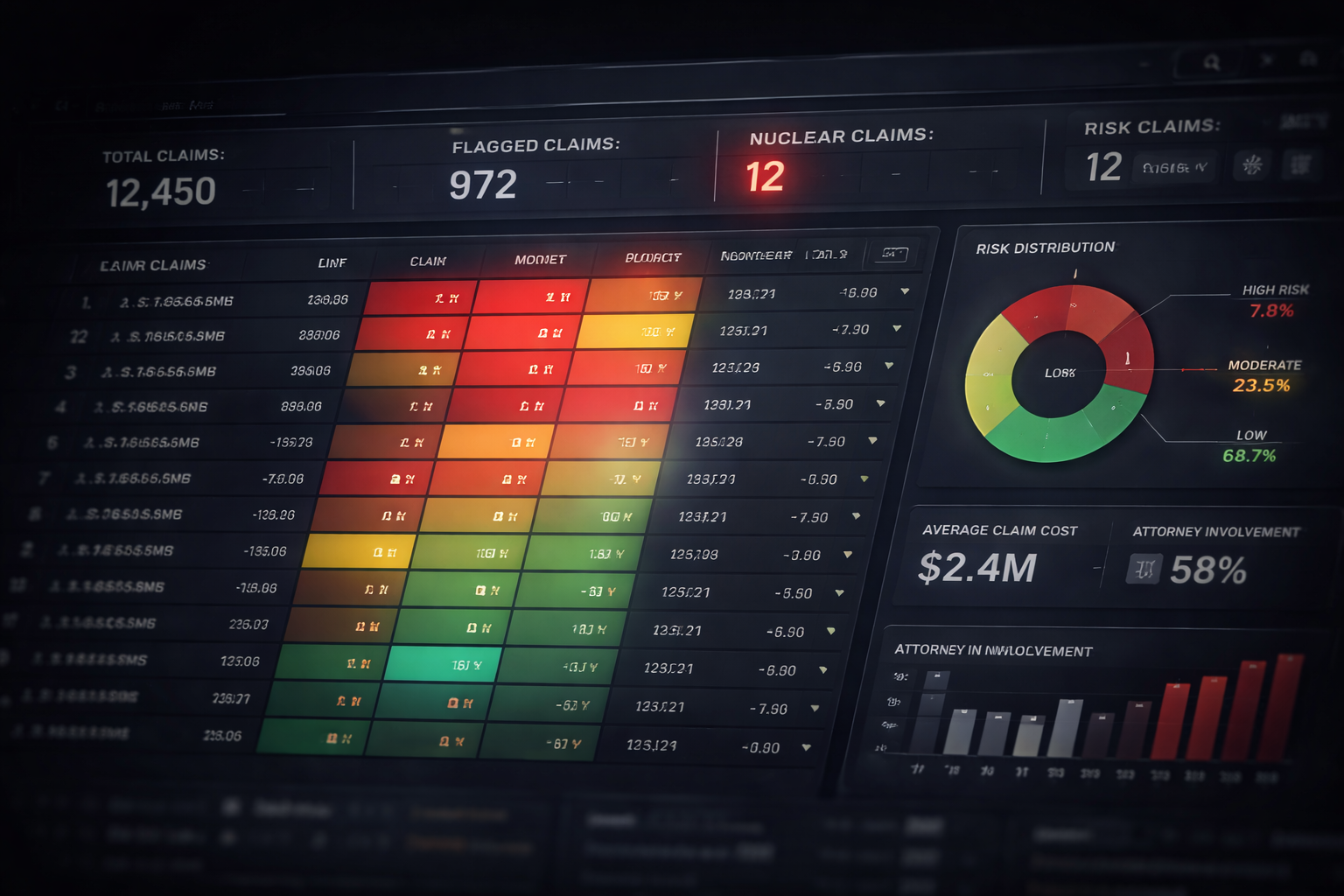
Schaefercity.ai can be positioned here as an early-warning solution that helps insurance professionals identify high-risk claims earlier, connect fragmented data, and act before Nuclear Verdict® exposure escalates. Applied to medical malpractice claims, that story becomes especially compelling because the strongest signals often appear well before a case looks catastrophic on the surface.
Want to identify medical malpractice claims with Nuclear Verdict® exposure earlier? Request a demo to see how Schaefercity.ai helps insurers move from reactive reporting to earlier risk detection.
FAQs
What is a nuclear verdict® in medical malpractice?
A nuclear verdict® generally refers to a jury award above $10 million. In medical malpractice, these verdicts often reflect not only the alleged clinical error, but also jury reactions to perceived systemic failures, preventability, and long-term care costs.
Why are medical malpractice nuclear verdicts® increasing?
Contributing factors include shifting jury sentiment, reptile theory, higher damages anchors, medical inflation, and the broader visibility of large verdicts across the legal market.
Why is reactive risk management a problem in med mal claims?
Reactive models rely on lagging indicators such as incident reviews and manual audits. By the time a pattern becomes visible, the claim may already be deep in litigation and more expensive to control.
What signals can indicate high-risk medical malpractice exposure early?
Common early signals include patient complaints, care delays, inconsistent documentation, communication breakdowns, and repeated workflow failures that can later be reframed as evidence of systemic negligence.
How can AI help insurers manage medical malpractice nuclear verdict® exposure?
AI can help insurers identify high-risk claims earlier, connect fragmented data sources, surface patterns across files, and support earlier intervention before exposure escalates into catastrophic verdict risk.